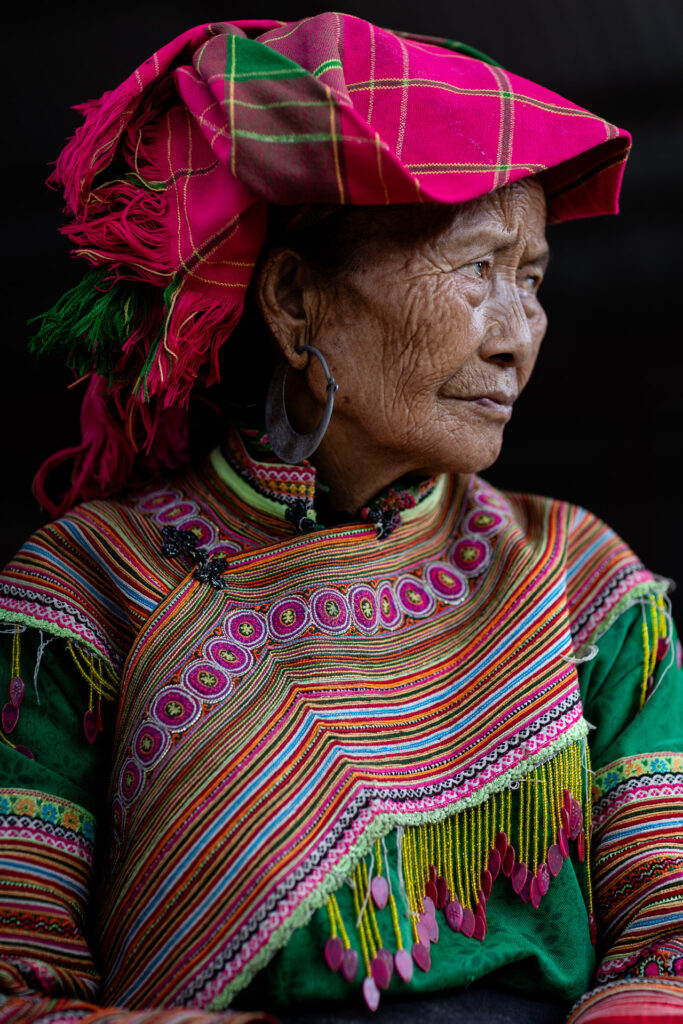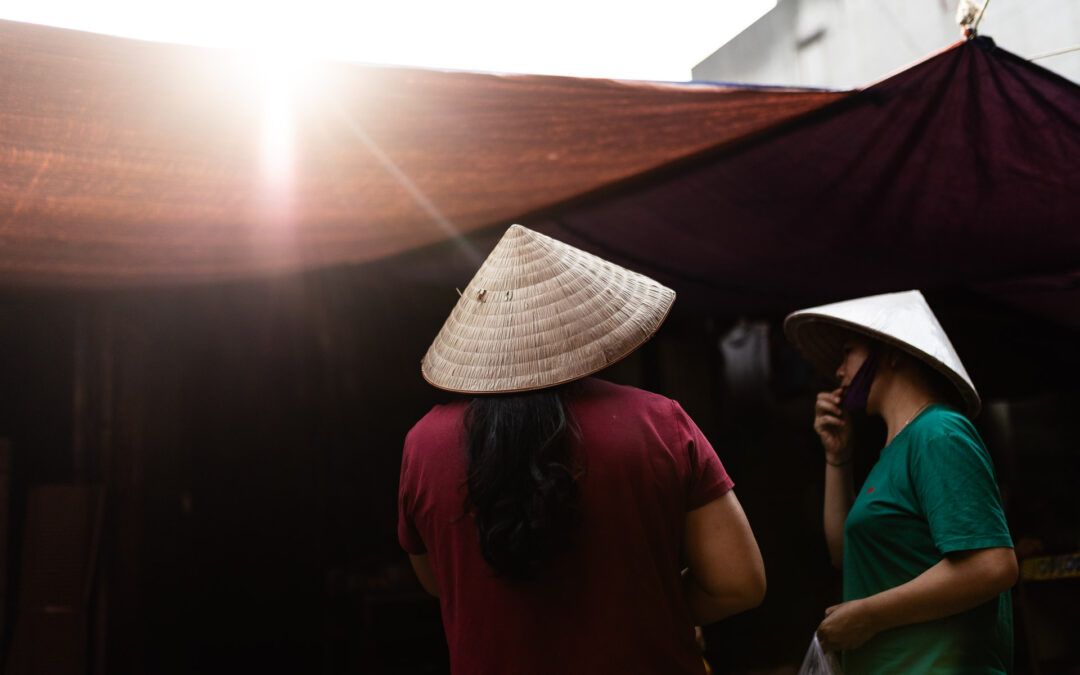
Every year, during our Vietnam photography tour, we return to the same local market in the mountains of northern Vietnam.
It is one of those places we keep coming back to, not because it is a famous tourist attraction, but precisely because it feels so alive and genuine. People from the surrounding communities come to trade, meet, shop and spend time together.
And every year, the market looks different.
Not because the market itself has changed dramatically, but because we see it differently.
The colours are impossible to miss. Traditional clothing, beautifully embroidered fabrics and, above all, the extraordinary scarves worn by many of the women create flashes of colour throughout the crowd. Add the movement of people, the stalls, the early morning light and the surrounding mountains, and you have everything a photographer could ask for.
But having beautiful subjects doesn’t automatically make beautiful photographs.
For our five guests this year, the market became something else: a photography lesson.
If you have followed our photography workshops before, you may remember our article about how to photograph a market in Asia. There, we explored some of the practical challenges of photographing markets — finding the light, simplifying the background, getting close and, above all, slowing down enough to wait for the right moment.
This time, rather than explaining the theory, we wanted to show what those ideas look like in the field, during one of our Vietnam photography workshops.
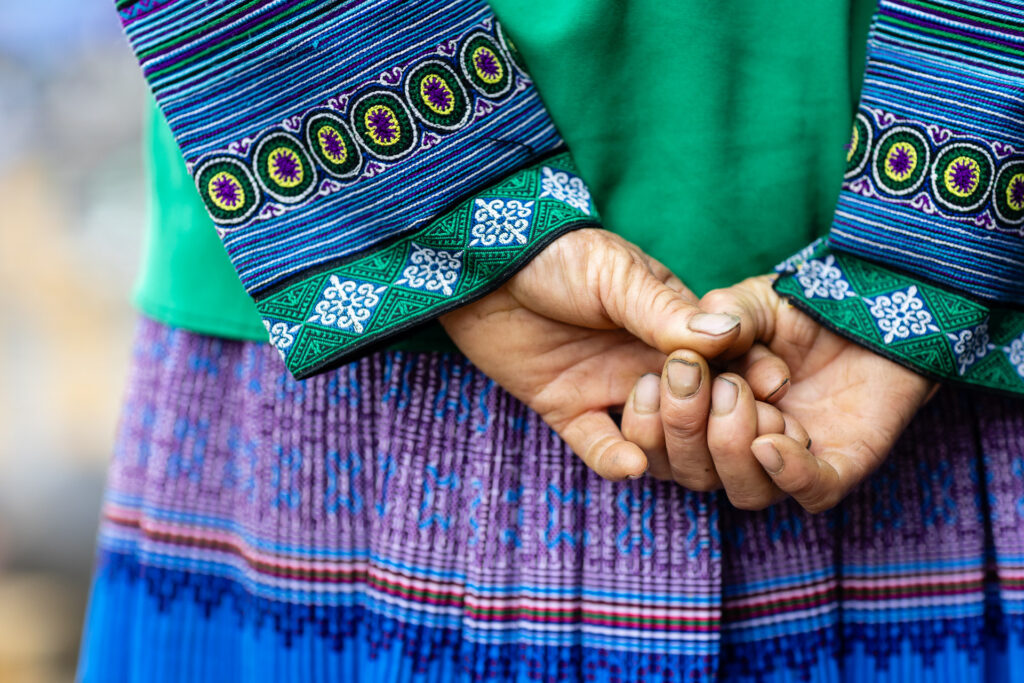
Five photographers, five trajectories
Our group this year was small – just five guests – but each arrived with a completely different photographic background.
Cara is our wildlife photographer. She is accustomed to observing animals, anticipating behaviour and waiting patiently for the right moment. At the market, those skills suddenly became very useful. Instead of chasing people through the crowd, she could observe and anticipate.
Simon was joining us for his third workshop after Uzbekistan in 2025 and Cambodia also in 2025. He already knows our approach and understands that photography isn’t about photographing everything that moves. It is about slowing down, observing and making deliberate choices. Coming back for a third time also allowed us to see how his photography has evolved.
Melissa is a landscape photographer. But during a previous workshop with Etienne from Pics of Asia, she started moving towards street photography. This time, with her 28mm lens, she was increasingly comfortable getting closer to people and working within the scene. It was fascinating to see a landscape photographer gradually becoming a street photographer.
Mindy is a young retired journalist. Her background naturally influences the way she photographs. She looks for people, details and stories. Rather than simply asking, “Is this a good picture?”, she often seems to be asking, “What is happening here?”
And Chris is a photographer and television videographer. He is used to movement, sequences and visual storytelling. But still photography forces a different discipline: sometimes an entire story has to be contained in a single frame.
Five photographers.
Five trajectories.
One market.
The first lesson: don’t chase your subject
A colourful market creates a very natural temptation.
You see a beautiful scarf.
Then an interesting face.
Then someone wearing a traditional costume walks past.
Then something happens at another stall.
And suddenly you are walking quickly through the market, trying to catch everything.
But the more you chase, the more difficult it becomes to create a strong photograph.
So we tried something different.
Don’t chase the subject.
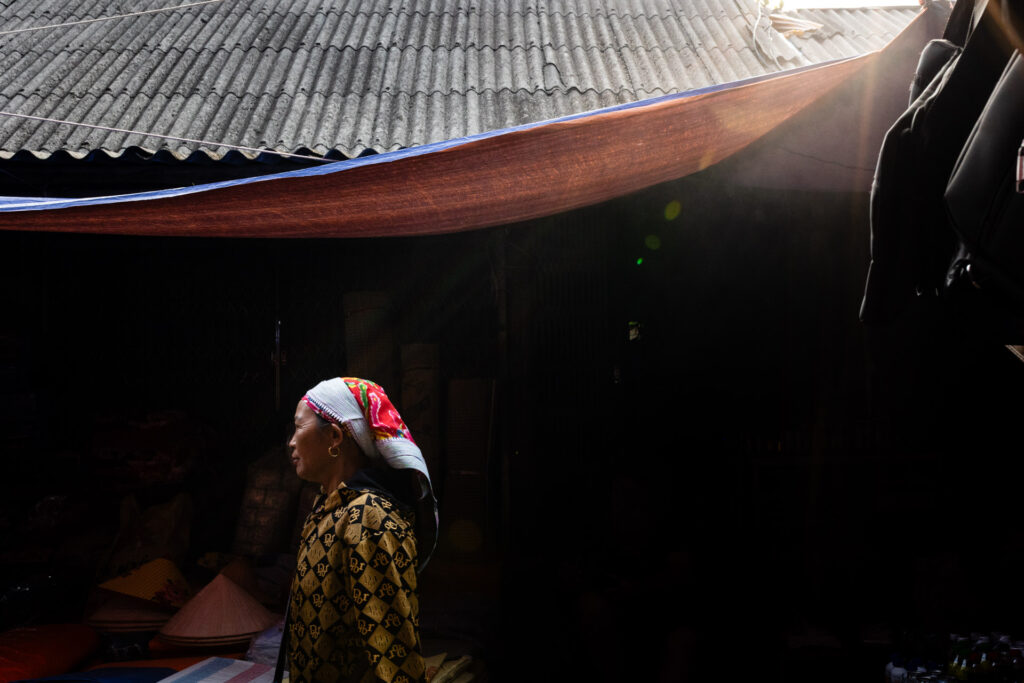
Look for the light first.
Then look for the background.
And then wait.
The market is constantly moving. People enter and leave your frame. Colours appear and disappear.
But if you find good light and a strong background, you have already created the conditions for a good photograph.
Now you simply have to wait for the right person — and the right moment — to arrive.
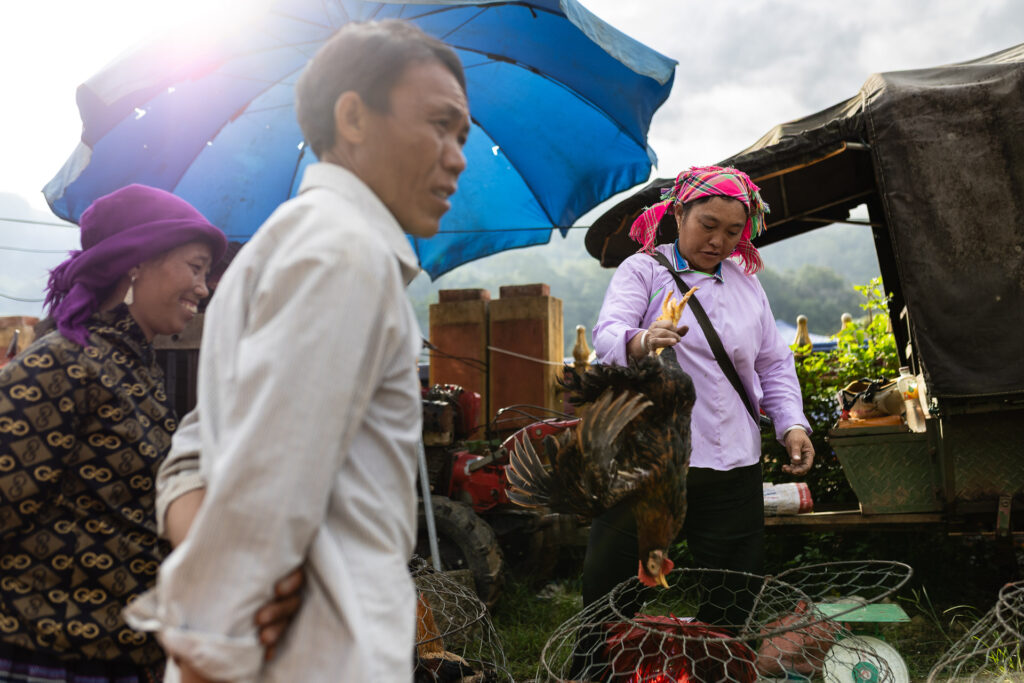
Light. Background. Subject. Moment.
This is one of the foundations of how we approach photography during our workshops.
Light.
Where is it coming from? How does it fall on someone’s face? What does it do to the colours of the clothing?
Background.
Does it strengthen the photograph or make it chaotic? Can you simplify it? Can the colours or textures become part of the composition?
Subject.
Who enters your frame? What are they doing? What makes the moment interesting?
And finally:
Moment.
When do those three elements come together?
The market gives us the perfect environment to practise this.
The colourful scarves and traditional clothes immediately attract our attention. But simply photographing a colourful person isn’t necessarily enough.
The real challenge is to combine light, background, subject and moment into one coherent image.
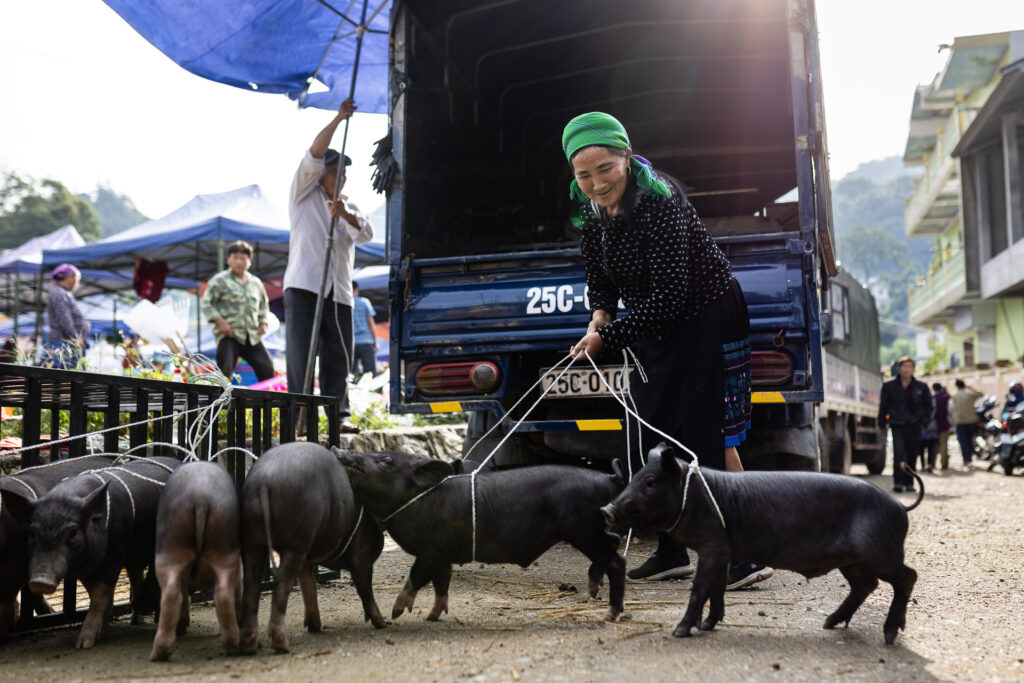
Don’t run
Perhaps one of the simplest pieces of advice we give our photographers is also one of the hardest to follow:
Don’t run.
Photography is often about slowing down.
Find something interesting.
Stay there.
Observe.
Wait.
You may see a patch of beautiful light falling onto an empty space. Instead of moving on because there is nobody there, wait for someone to enter it.
Perhaps it will be a woman wearing a bright traditional scarf.
Perhaps two people will stop to talk.
Perhaps someone will turn towards the light.
Or perhaps nothing will happen.
That’s photography.
You cannot force the moment.
You can only be ready for it.
Approaching people with respect
The other important lesson in a market like this is not technical at all.
It is about how we photograph people.
These are not models.
They are not performers.
They are people going about their daily lives.
So we encourage our photographers to approach them with respect and curiosity. A smile, eye contact, a gesture or a few words can completely change the interaction.
And sometimes, the answer is no.
We accept that.
Respect also means understanding that photographing someone does not necessarily mean asking them to pose.
A genuine connection can produce a much more natural photograph than immediately turning someone into a portrait subject.
For us, travel photography is about encountering people, not collecting photographs of them.
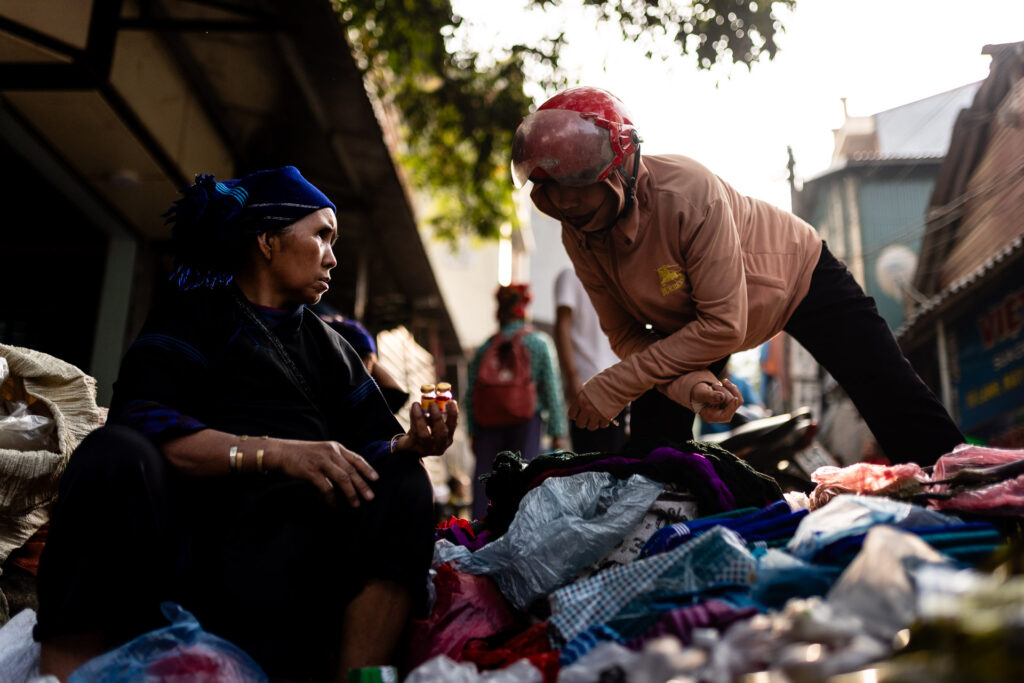
Five photographers, five ways of seeing
What makes returning to this market every year so interesting is that we never know exactly what will happen.
And we never know exactly how our photographers will respond.
Cara observes like a wildlife photographer, waiting for behaviour and timing.
Simon brings three workshops of experience and an increasingly personal way of seeing.
Melissa moves through the market with her 28mm, getting closer and closer to the people and discovering a new side of her photography.
Mindy looks for the story behind the scene.
Chris searches for the decisive frame, bringing his experience of visual storytelling from television into still photography.
They are all standing in the same market.
They all have access to the same light, colours and people.
Yet they don’t make the same photographs.
And that’s exactly the point.
A photography workshop isn’t about teaching everyone to photograph in the same way.
It is about helping each photographer discover their own way of seeing.
The market we return to every year
We will probably come back again next year.
We’ll walk through the same market.
We’ll see the same colourful scarves and traditional clothes.
We’ll look for the same early morning light.
But the photographs won’t be the same.
Because the photographers won’t be the same.
And because photography is never really about the place.
It is about how you see the place.
Find the light.
Find the background.
Wait for the subject.
Wait for the moment.
Approach people with respect.
And above all, don’t run after every photograph that passes in front of you.
Sometimes the best photograph is the one you wait for.
Five photographers.
Five trajectories.
One market.
And, every year, another lesson learned.