
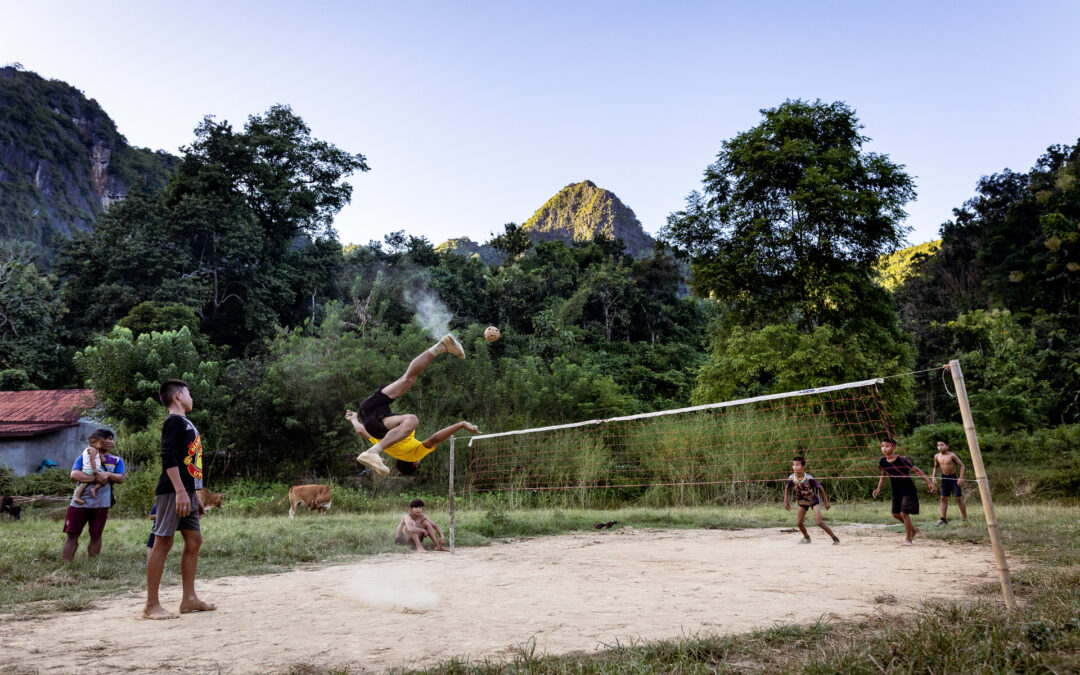
Travel Photography Ethics: Staged Images, Workshop Culture, and the Crisis of Authenticity
First, I would like to thank Justin Mott for helping reopen an important and necessary discussion about honesty in travel photography.
I would also like to acknowledge Etienne Bossot, who continues to raise similar questions about authenticity and ethics in the industry, including through discussions such as PetaPixel’s “Library of Fake Travel Photos”. Even when perspectives differ, the fact that this conversation continues matters.
At the same time, I believe photography should remain open. Everyone is free to enjoy their own approach — documentary, staged, commercial, or artistic — as long as there is clarity and honesty about what is being created.
Because that is where the real issue begins:
not creativity,
not aesthetics,
not staging itself,
but the growing confusion between reality and performance.
This debate matters because staged travel photography, fake documentary imagery, and manufactured authenticity are becoming increasingly normalized across social media, photography workshops, and competitions.
Interestingly, I already explored part of this issue several years ago in my article What Kind of Travel Photographers Are You? where I questioned the growing obsession with staged “authenticity,” copy-paste photography tours, and the quiet removal of reality in favor of more marketable images.
But today, the problem feels deeper.
Travel photography is slowly losing its soul.
Not because technology changed.
Not because social media exists.
Not because photographers edit too much.
But because too many photographers no longer travel to understand the world.
They travel to manufacture approval.
And that changes everything.
The Ethics Crisis in Modern Travel Photography
Modern travel photography is facing a growing ethics crisis.
The line between documentary photography and staged performance has become increasingly blurred. Images are often presented as authentic cultural moments while being carefully constructed for workshops, tours, or social media.
The issue is not staging itself.
The issue is honesty.
When viewers believe they are seeing reality, but are instead seeing controlled or repeated setups, photography stops being documentation and becomes performance.
Why Staged Travel Photography Is Becoming Normalized
Across many destinations, staged travel photography has become an industry.
Photographers encounter:
- arranged portraits
- recreated cultural scenes
- controlled smoke or lighting effects
- traditional costumes used as props
- repeated setups designed for visiting photographers
The same subjects are often photographed hundreds of times, repeating the same gestures for different groups of guests.
Yet these images are frequently presented as spontaneous moments.
That is where the ethical tension begins.
Pre-Manufactured Expectations in Photography Workshops
Travel photography used to begin with curiosity.
Today, it often begins with expectation.
Many photographers arrive already knowing what they want to create. Locations are chosen because they have been seen online. Subjects are selected because they are already proven to win awards. Compositions are copied because they already perform well in feeds, contests, and portfolios.
Nothing is truly discovered anymore.
Everything is reproduced.
In fact, I have often had guests joining photography workshops where the goal was not exploration, but reproduction — repeating images already created by the workshop leader, sometimes hundreds of times with hundreds of different participants.
At some point, this raises an uncomfortable question about creativity itself.
If dozens, or even hundreds, of photographers are producing nearly identical images in the same locations, guided toward the same compositions, the same light, and the same subjects, then where does personal vision actually begin?
And what is left of authorship in that process?
Entire photography tours are now built around guaranteed images: the same fishermen, the same monks, the same weavers, the same elderly faces, the same smoke-filled rooms, the same mountains, the same aesthetic formulas.
Hundreds of photographers leave with almost identical portfolios while believing they experienced something unique.
But collecting images is not the same thing as understanding a place.
The Loss of Curiosity in Documentary Travel Photography
One of the most concerning shifts in modern travel photography is the decline of curiosity.
Many photographers no longer ask questions. They no longer take time to understand people or context. They no longer engage with reality unless it improves the image.
Everything becomes extraction.
A village becomes a backdrop.
A face becomes texture.
A ritual becomes content.
People are reduced to photographic opportunities.
And once photography becomes transactional, empathy quietly disappears.
This is the ethical crisis very few want to talk about openly.
Many “Authentic” Images Are Emotionally Empty
Modern travel photography often looks impressive.
Perfect light. Perfect composition. Perfect color. Perfect atmosphere.
But emotionally, many of these images say very little.
Because they are often constructed backwards.
The aesthetic comes first. The reality is adjusted to match it.
As a result, the photograph may be visually powerful but emotionally hollow — containing no real observation, no tension, no contradiction, and no understanding.
Reality is not an advertisement.
Cultures Are Not Props
One of the most uncomfortable truths in travel photography is how easily cultures are turned into visual stereotypes.
Photographers often search for simplified ideas:
“untouched tribes,”
“timeless traditions,”
“authentic faces,”
“primitive lifestyles.”
The language itself already reveals the problem.
Many photographers are not documenting living societies. They are searching for visual confirmation of an idea they already carry.
Modern life becomes a disruption to that fantasy.
A satellite dish feels wrong.
A red plastic chair feels out of place.
A smartphone feels too modern.
But people are not responsible for maintaining someone else’s visual expectations of authenticity.
Cultures evolve.
Societies change.
Traditions adapt.
Authenticity is not the absence of modernity — it is the presence of real life.
As I wrote previously in What Kind of Travel Photographers Are You?, authenticity is not about removing reality from an image. Reality itself is already authentic.
Photography Competitions Reinforce the Problem
Photography contests rarely reward nuance.
They reward impact.
As a result, photographers are pushed toward stronger, more immediate visual emotions: more drama, more contrast, more atmosphere, more “wow factor.”
Over time, this creates a predictable visual language where entire regions are reduced to simplified ideas.
Complex societies become aesthetic categories.
Living cultures become visual formulas.
The world is no longer seen as it is, but as it performs best.
And once those patterns are rewarded, they repeat endlessly.
That is not cultural understanding.
That is visual branding.
Travel Photography Often Rewards Distance Instead of Connection
Many photographers travel the world while remaining emotionally distant from it.
They plan images more than conversations. They optimise shots more than relationships. They leave with thousands of photographs but often without meaningful human connection.
And audiences can feel that distance.
Because a photograph built on genuine connection carries something that cannot be faked — a sense of presence.
No amount of technical perfection replaces that.
What We Believe In Instead: Real Cultural Experiences
This is also why our philosophy has always been different.
Our photo workshops are created by photographers for photographers. But behind the photographer, we are first and foremost human beings — travelling, interacting, and meeting real people in real environments.
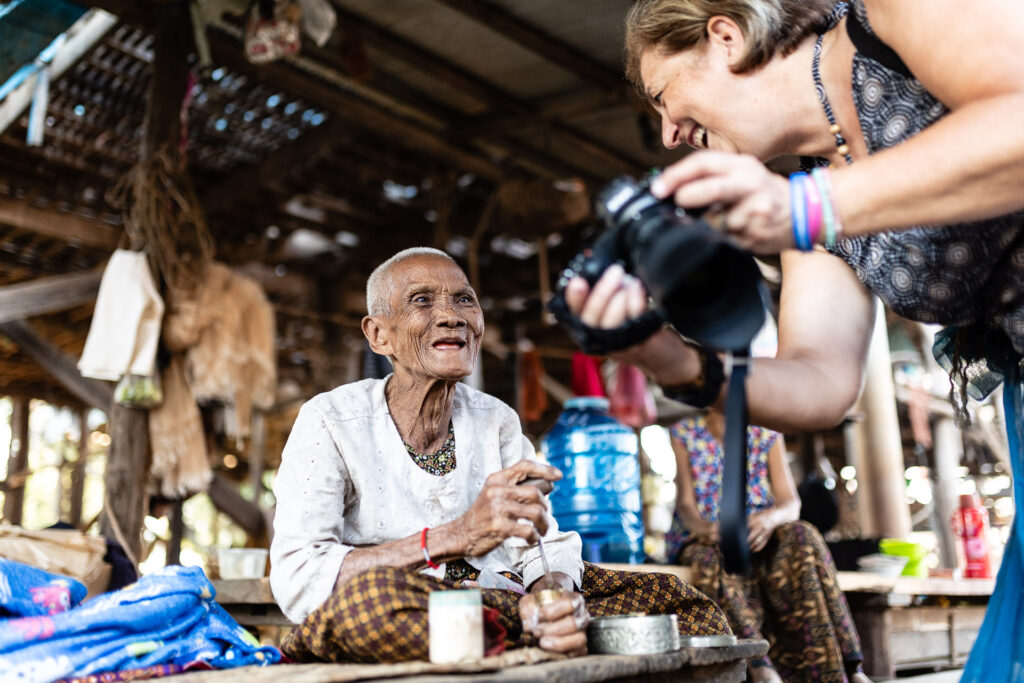
We do not design experiences around manufactured scenes.
We design them around real encounters.
That distinction matters.
Because what we offer is not a photographic production line. It is a lived experience inside a culture — unpredictable, sometimes uncomfortable, always real.
We work with people, not sets.
We build relationships, not stages.
We enter daily life rather than replacing it with curated versions of reality.
And in that reality, things are not controlled.
The background is not perfect.
The environment is not cleaned for the camera.
Life continues while you are photographing it.
This is where real photographic skill becomes essential.
We encourage photographers to find their image — not by changing reality, but by learning how to work within it.
Very often, guests will ask to remove something in the background because it feels distracting or “ruins” the composition.
Our answer is always no.
Instead, we guide them to solve it photographically.
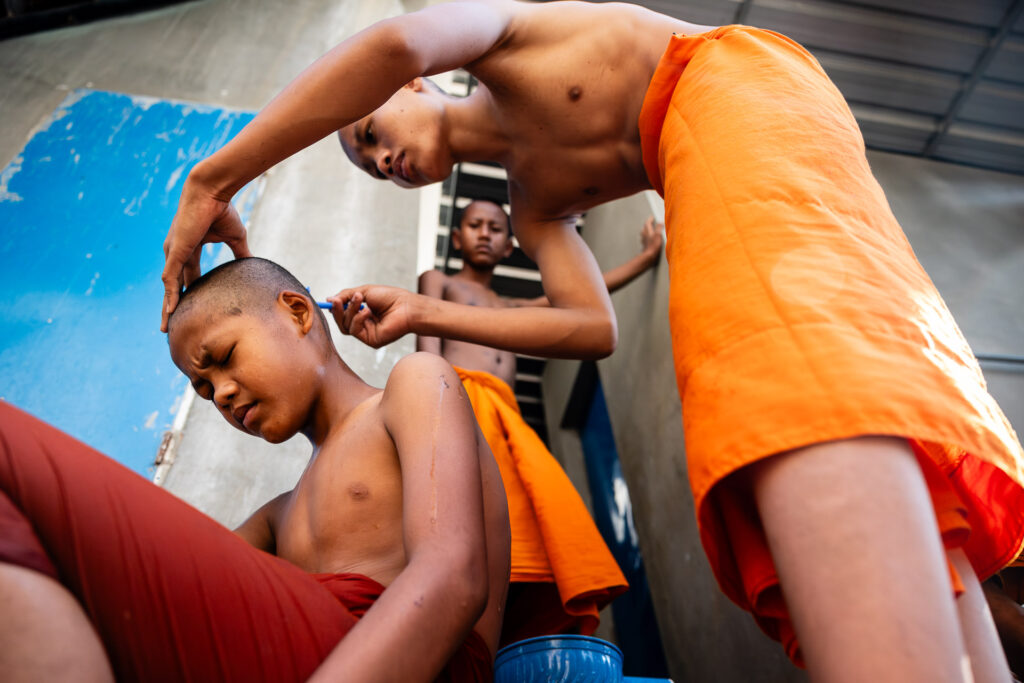
Move your feet.
Squat down.
Change your angle.
Step left or right.
Reframe the subject against a different layer of reality.
Because learning photography is not about controlling the world.
It is about learning how to see within it.
A distracting background is not something to eliminate — it is something to work with.
More often than not, the strongest image comes from understanding how to position yourself so the subject naturally separates from its environment.
That is a core part of what we teach.
To stop asking reality to adapt to the camera.
And instead learn how the camera adapts to reality.
This approach does more than produce better photographs.
It builds awareness, patience, observation, and respect for real environments.
And just as importantly, it keeps the experience honest.
Because we are not here to recreate reality.
We are here to experience it.
Together.
Honest Photography Can Still Be Powerful
Criticising staged authenticity does not mean rejecting strong imagery.
Some of the greatest travel photographs ever made are visually powerful, cinematic, and emotionally intense.
Light, timing, composition, and atmosphere still matter deeply.
But power does not require fabrication.
Honest photography can still be beautiful, dramatic, and compelling.
The difference is where the emotion comes from.
Reality already contains enough depth, contradiction, and beauty to create powerful images without needing to be staged or simplified.
And viewers often sense that difference instinctively.
The problem is not beauty.
The problem is when performance replaces truth.
Because then photography may still look impressive — but it begins to lose meaning.
Maybe Photographers Need To Slow Down Again
Today, too many photographers consume destinations instead of experiencing them.
They move quickly, collect images, and leave with souvenirs instead of understanding.
But meaningful photography often requires the opposite:
slowness, patience, observation, conversation, uncertainty.
Sometimes the most important shift is not finding better images.
It is learning to see differently.
To stop repeating what already works.
To stop chasing approval.
And to start paying attention again.
Because travel photography only becomes meaningful when curiosity matters more than performance.
And right now, performance is still winning.